Launching a Store-Based
Fulfillment Operating Model
Galeries Lafayette
To expand e-commerce revenue and unlock in-store inventory,
the Paris Haussmann flagship needed to fulfill next-day deliveries directly from store stock.
We designed the operational and digital system enabling this capability in a live retail environment.
-
€300K
Revenue generated in the first 3 weeks.
-
2×
Order volume vs initial targets.
-
30-40
Orders in first days.
Context
As part of its digital transformation, the Paris Haussmann flagship sought to integrate in-store inventory into its e-commerce fulfillment network.
The ambition was to expand online assortment, increase flagship revenue contribution, and reduce delivery times within Paris, without disrupting daily operations.
However, the store relied on paper-based coordination, siloed departments, and had no defined fulfillment operating model.
The Real Problem
The challenge was systemic, not technical.
Operational gaps
- No cross-department order visibility
- Manual handoffs between sales and warehouse
- No structured lifecycle for online orders
Organizational gaps
- No ownership model
- No incentive alignment
- Online orders invisible in store value chain
Without redefining workflows and accountability, any digital tool would have been bypassed.
Structuring Discovery
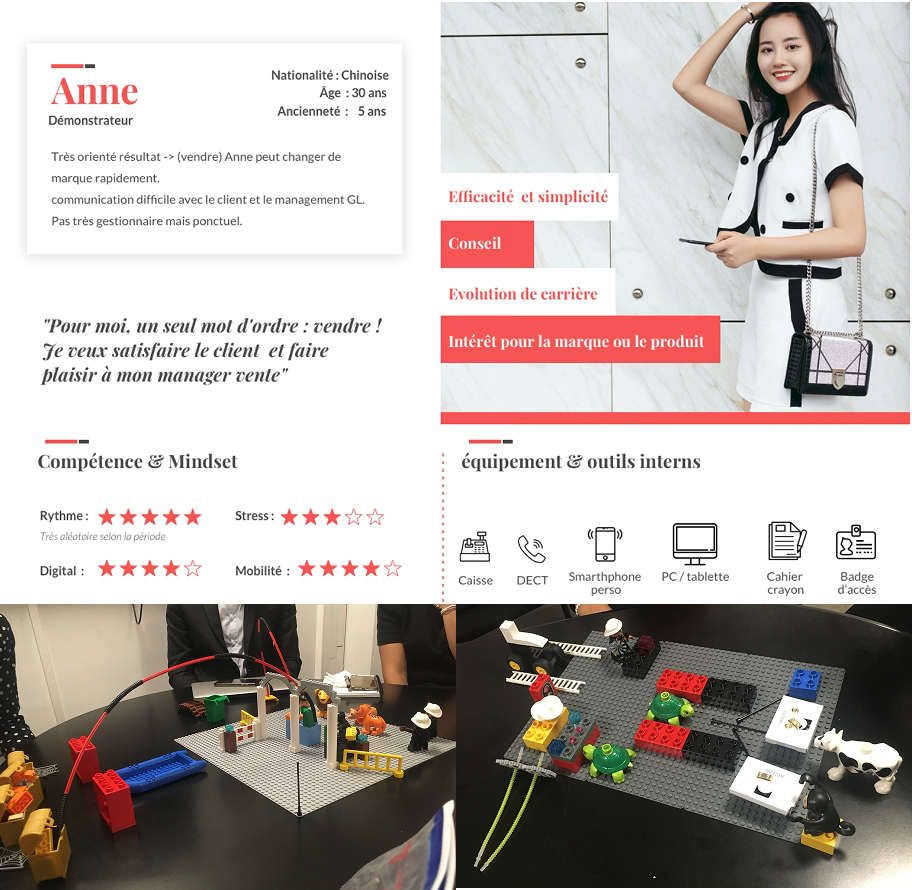
We conducted stakeholder interviews to clarify business constraints, success metrics, and operational dependencies.
Instead of running conventional workshops, we used Lego Serious Play to externalize workflows and surface systemic friction.
Why this mattered
- Departments had limited collaborative history
- Process ownership was fragmented
- Discussions were often abstract and defensive
Impact of tangible modeling
- Bottlenecks became visible
- Redundancies surfaced
- Ownership gaps were exposed
- A shared mental model emerged
This alignment work preceded solutioning. It reframed the initiative from "building a tool" to "structuring a capability."
Operating Model Redesign
Based on discovery insights, we formalized a structured store-based fulfillment operating model.
-
Clear order lifecycle stages
Alert → Claim → Preparation → Pickup → Dispatch. -
Explicit role accountability
Sales advisors and warehouse handlers were assigned defined responsibilities at each stage. -
Shared visibility layer
Real-time status tracking replaced manual coordination. -
Performance & recognition mechanisms
Dashboards introduced measurable contribution and managerial visibility.
In frontline environments, adoption depends as much on recognition structures as on usability.
Service & Tooling Design
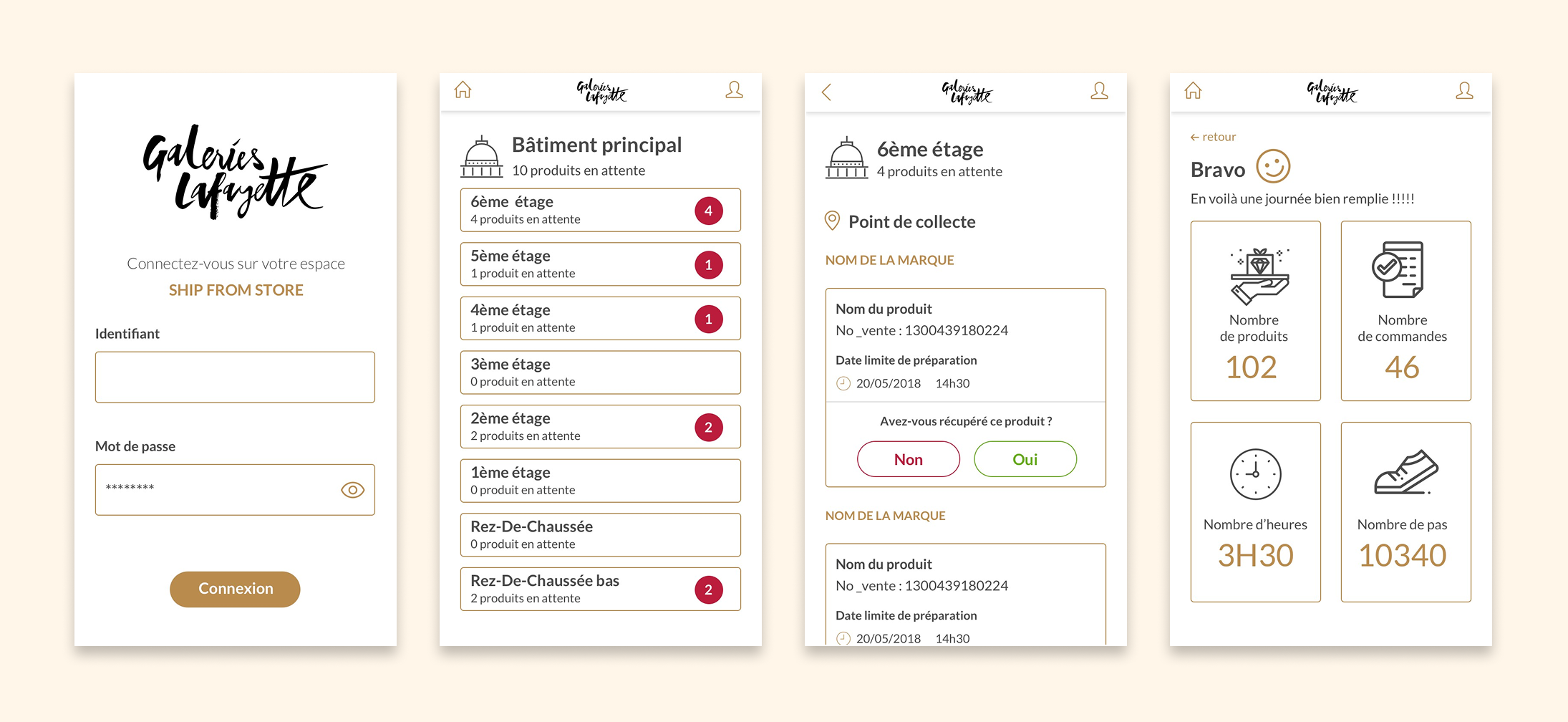
The staff application was designed to integrate seamlessly into existing accounts and hardware constraints.
- Minimal cognitive load
- Clear status signaling
- Error reduction through visual reinforcement
- Collaborative feasibility validation with engineering
Impact & Leadership
-
€300K
Revenue generated in the first 3 weeks.
-
2×
Order volume vs initial targets.
-
30-40
Orders in first days.
Leadership Perspective
-
Operating models precede interfaces.
Digital tools amplify existing systems. Structuring the workflow was a prerequisite to designing the interface. -
Alignment is a design deliverable.
Building shared mental models reduced delivery friction and accelerated execution. -
Incentives shape adoption.
Recognition mechanisms were as critical as usability in driving frontline engagement. -
Systems thinking builds strategic credibility.
Positioning the initiative as capability-building shifted design’s role from execution to strategic contribution.